
The short answer
A DJ offers musical range, original recordings and continuous adaptation. A live band offers human energy, stage presence and a unique performance. For many weddings, the strongest result is a planned combination with clearly defined roles, chosen around the guests, venue and flow of the reception.
The question “wedding DJ or live band?” often begins as a price comparison. In practice, it describes two different experiences. A band carries the immediacy of live performance. A DJ can move through a much larger music library without being limited by repertoire, arrangements or instrument changes.
The right option depends on your guests, the musical backgrounds of both families, the venue, schedule and the moments you want to feel live. One option does not have to cancel the other. Start with the available wedding entertainment and live performer options.
The fundamental difference in experience
Range and flow
Thousands of original recordings, immediate changes of direction and continuous mixing without required breaks.
Presence and interpretation
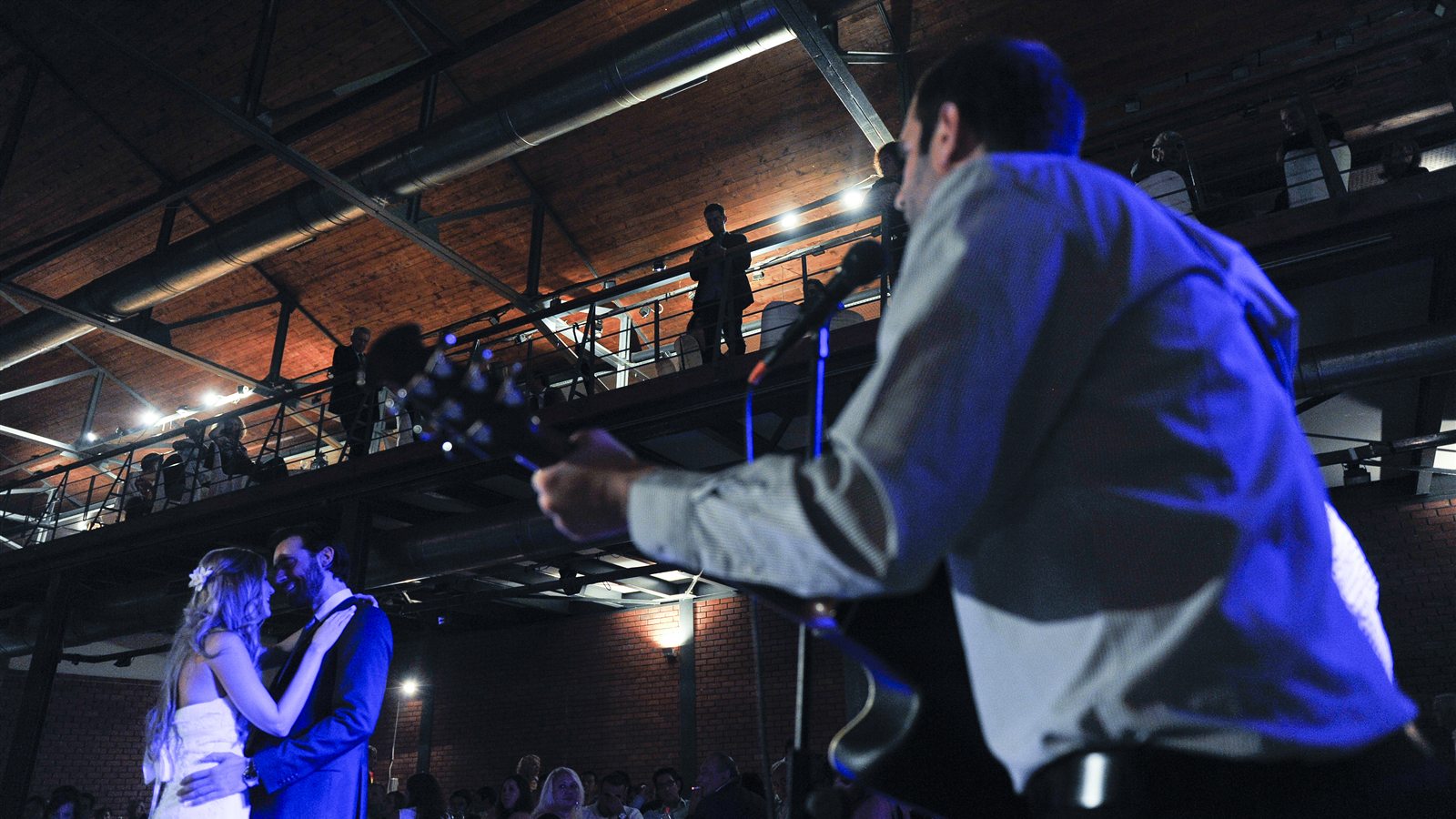
Human interaction, visual energy and a performance that only exists in that particular moment.
Two dimensions
Live highlights with a DJ providing the wider musical range, connected through one run of show.
A Greek traditional or popular ensemble may deeply engage guests who share that repertoire. A saxophonist or percussionist can bring a live dimension to a contemporary DJ set. A multigenerational or international audience may need the DJ's range to move naturally between Greek and international music, disco, pop, Latin and modern dance.
Wedding DJ and live band: detailed comparison
| Criterion | DJ | Live band |
|---|---|---|
| Musical range | Very broad, using original recordings and remixes | Defined by repertoire, line-up and rehearsals |
| Adaptation | Immediate shifts in genre, period and energy | Possible within the songs the band performs |
| Stage presence | Can be discreet or energetic, depending on style | Naturally strong because the music is performed live |
| Continuous flow | No necessary performance breaks | Requires planned sets and breaks |
| Space | Usually a smaller physical footprint | Stage area, monitors, microphones and access |
| Preparation | Music brief, edits, cues and technical checks | Repertoire, rehearsals, soundcheck and stage plan |
How to compare the total cost
There is no reliable answer to “how much does a wedding band cost?” without a complete brief. A DJ price and a band price are not comparable until every inclusion is clear. Live music costs are shaped by the number of musicians, rehearsals, travel, set length and sound requirements. DJ costs are shaped by hours, sound coverage, lighting, zones, crew and technical support.
A hybrid format may share part of the sound system, but that does not automatically reduce every cost. Inputs, monitors, microphones, mixer capacity, soundcheck and technical operation must still be confirmed. Two services using the same speakers do not necessarily have the same production needs.
Do not ask only whether a band costs more than a DJ. Ask what experience each option covers, for how long, with which equipment and who coordinates it. Our wedding DJ pricing guide owns the detailed pricing factors, while this page remains a decision guide.
Space, soundcheck and technical requirements
The venue may influence the choice more than musical taste. A band needs a safe stage or clear performance zone, suitable power, loading access, enough soundcheck time and a position that does not conflict with tables or the dance floor. In a smaller venue, a compact live act or solo performer may work better than a full band.
Speaker placement must support both the live act and the DJ. Levels do not need to be identical in every area: guests should be comfortable at their tables, while the dance floor needs clarity and energy. See the detailed wedding sound system guide.
When a hybrid format works best
The combination works when each side has a clear musical role. A wedding band may perform a focused traditional or popular set, while the DJ connects the welcome, breaks and the rest of the party. Alternatively, DJ and saxophone, violin or percussion can join for selected peaks within a prepared set.
- Create one run of show. Record the start, duration and finish of every live set, entrance and planned moment.
- Divide the musical territory. Clarify who handles each style to prevent repetition and competition.
- Design the transitions. The DJ covers stage changes and breaks without making the evening feel paused.
- Assign one technical lead. One person coordinates line check, microphones, monitors, levels and final cues.
| Format | Typical development | Critical coordination |
|---|---|---|
| DJ throughout | Cocktail, entrances, dinner and party as one continuous story | Brief, cues and live dance-floor response |
| Live band + DJ | Focused live set with DJ before, between and after | Shared repertoire, soundcheck and clean transitions |
| DJ + sax or percussion | Live interventions at selected peaks of the DJ set | Core cues, monitors and performance duration |
How to decide with confidence
- Begin with the moments. Which should feel live and which need a very wide musical range?
- Consider the audience. Which generations and cultural references need to meet?
- Audit the venue. Is there space, soundcheck time and infrastructure for the format?
- Request a complete cost. Include musicians, DJ, sound, technicians, travel and overtime.
- Assign one owner of the flow. A hybrid format succeeds when someone sees the whole evening.
Frequently asked questions
DJ, live band or both?
What is better for a wedding?+
There is no absolute answer. A DJ offers range and continuous adaptation, while a band offers live interpretation and stage presence.
Can a DJ and band work without awkward gaps?+
Yes, when they share one schedule, prepare the transitions and work with a clearly assigned technical lead.
Which option needs more space?+
Usually the live band, depending on the number of musicians, monitors, microphones and stage layout.
How should we compare prices?+
Include every hour, musician, sound requirement, technician, transfer and piece of shared or separate equipment.